In Brisbane, "South Bank" is an area of downtown along one of the southern river banks developed for tourism and local culture. I suppose the most immediately identifiable landmark is The Wheel of Brisbane, a 60 meter tall modern ferris wheel. It has 42 enclosed gondolas which could seat six, but they will give you by yourself, which take you on a narrated 15 minute windshield tour of everything within sight, which is most of downtown Brisbane.
While definitely the most blatantly touristy thing I did my entire trip, it was also one of the most enjoyable. On this particular day, it was particularly attractive because each of the enclosed gondolas is individually air conditioned. It also gave me a chance to get the pictures in this post.
Kurilpa Bridge over the Brisbane River
On the east end of South Bank is a footbridge that runs over to the Courthouses in that area of Brisbane called the Kurilpa Bridge. I walked over this bridge frequently, not knowing it is the world's largest hybrid tensegrity bridge. That's a fascinating rabbit hole of it's own, if you're an engineering nerd like I, follow this linkage.
I walked over it frequently because it was the most direct route from where I was staying to the South Bank. The South Bank has the Art Museum, the Performing Arts Center, a botanical garden with a rainforest boardwalk, and an actual beach. It's a great place to walk around and take in the local plants and watch the traffic on the river.
Kurilpa is an aboriginal word which means "place of large river rats." It is thought now they were probably referring to possums, which are common in Australia, and of course, marsupials like wallabies and kangaroos. I didn't see any.
What one did see was a lot of these very strange looking birds, the Australian White Ibis. They are tame around people. The behave like pigeons do in NYC. Human scraps are a major part of their diet. Their favorite meals are crayfish and mussels which they dig with that long beak.
Just as with NYC pigeons, they would fly close enough to you to fan you with their wings. I'm guessing they aren't very good to eat. They're big, this one is the size of a large chicken or small turkey. I wasn't quick enough to get a shot with something in it for scale.
I shot this picture in the park outside the Queensland Art Museum. A woman about my age was nearby with her camera. We tripped our shutters at the same time. I commented "I think we got the same picture" playfully in her direction.
She sat down on the bench next to me and told me she was a watercolorist visiting the museum for inspiration. She complained of not finding inspiration inside but said she thought she would paint this bird, which she called a Pelican. We talked for a few more minutes about painting. I told her about my mother's painting. She reminded me of her.
This post will be the last in my series about Brisbane. This video below is from my ride in the Wheel of Brisbane, near the top. Thanks for reading along. Thanks for your patience with my decision to do this at the same time I was shifting technology.
Take the Benleagh train to
Moorooka and follow these flowers.
I had the honor and privilege of practicing zen at Queensland Zen Centre on 18 March 2018. The usual schedule was slightly altered due to the Guiding Teacher's illness. Their website, linked above, should be taken as a model for zen center websites. I should have paid more attention to it myself.
Their practice that Sunday morning was just as they describe on the website, except Zen Master Senshin did not participate: "Our practice periods begin with three prostration bows and a period of chanting meditation. We chant traditional Buddhist sutras and chanting books are provided. After chanting, periods of sitting meditation - following the breath, in stillness and silence - alternate with walking meditation. In addition, individual interviews with our teacher, Zen Master Senshin, are held as part of our Sunday morning practice. We close with the Four Great Vows and three prostration bows, and then there is time for refreshments, questions and discussion. Instruction in each of the practice forms is offered throughout the session."
I included a visit to a zen center on this trip because zen practice is an important part of my life. If I am not able to become comfortable practicing zen in Australia I won't live there. I did not think it would be a problem, but enlightenment is not what you think.
I was greeted warmly at the door by the same person with whom I had been corresponding over email, one of the senior training teachers. It was a warm morning, my skin was sticky from a very brief walk from the train station. After putting away my bag and turning off my phone I was offered water and pleasant instruction in the information quoted above. It is so refreshing to see a zen center keep their website tidy.
I have to "tilt the bell" a bit with my practice because of arthritic knees. They hold up fine for walking and sitting on western furniture. Zen practice often includes deep prostrations and floor-sitting which can cause my knees to hurt. The way that I cope with the pain often causes me to interfere with the pace of the group. For this reason, when sitting with a group at a new center, I make a point to request to sit in a chair and permission to substitute deep, standing bows for full prostrations.
They didn't give me time to request these accommodations, they suggested them. They have their attention on the right things. This was deeply comforting.
The lineage of the teacher is a bit unusual for my experience. I sit with two traditions. One is Soto Zen, and my line of teachers goes directly back to Dogen, who founded it about fourteen-hundred years ago. I have one "generation" of American teachers between myself and Dainin Katagiri, who was Japanese, trained in Japan, and has a Japanese lineage all the way back to Dogen.
The other tradition I sit with is Theravada, and loosely so, tracing back to an Australian who trained in a Thai lineage. My sangha is urban, young, and led by an ex-punk covered in tattoos out of the hippest parts of Manhattan and Brooklyn.
I took the precepts in the former lineage. I sit sesshin, a formal silent continuous practice period of several days, with the former lineage. I suppose I look to it as my religious authority. I sit regularly with the latter lineage, they are local, and the talks have been very valuable to my understanding.
There's a Korean influence on practice at Queensland Zen Centre, or it's probably more correct to say there's a Japanese influence on Korean practice here. It's hard for me to say from my perspective, which is almost exclusively in the American adaptative tradition of the Japanese style of zen. They chant in Korean, and instead of chanting, they really sing, and in beautiful evocative Korean scales and melodies.
I was familiar with the sutras we chanted, just the English or Japanese versions, and some of the briefer chants were in English as well. Chanting is a fascinating practice and "understanding" the language contains a lot of ultimately fruitless attention to the illusory separately-existing individually-identifiable self which is all the problem to begin with! I loved this Korean chanting. Here's an example from YouTube:
This is a challenge for a newcomer, I have neither seen phonetic Korean before nor have I heard the gorgeous melodies. Sincere practice means "seeing" the chant with my ears and following along every moment, diving as directly into now as one can. Staying silent would be far too attentive to the illusional self that is experiencing all of the awkwardness.
Chanting along anyway feels awkward, but the practice is profound. I would never have another chance to be brand-new to this style of chanting again. I was very grateful to have this chance with a sangha that was both tolerant and did not hesitate to offer instruction when appropriate.
It was most comforting that the senior training teachers would speak up and correct errors in practice at the time they became worthy of it. Instruction was direct, brief, helpful and delivered with kindness. I gave them a few chances to exercise their skills myself.
One of the most charming aspects of their practice is they do walking meditation outside. The center is in a residential neighborhood, in a former private residence. It has a backyard. They conduct walking meditation at a moderately fast pace, and they wind right out the front door and on to the beautiful patch of earth in the area. Birds are singing in the trees, geckos are croaking on the porch.
This also provides an additional challenge to this newcomer. I wore hiking boots to the center, not expecting to have to put them back on during that morning's practice. I usually put them on in a sitting position using both hands and a shoehorn.
I did what I could, but I had to get out of line to do it, which was a hassle I didn't need. Taking them off again was just as problematic. Lesson learned: bring sandals to Australian zen.
They sit facing in, which tempts my mind to wander in a way that facing the wall, as we do in Soto practice, does not. Counter to what one might assume, sitting facing inward causes me to close my eyes, which is a bad idea in meditation. I don't usually face this particular challenge, so it was interesting to see what my mind did with it.
After the practice period, we sat for about an hour on the back porch and chatted with snacks. Two very kind members of the sangha offered to drive me back to the part of Brisbane I was staying in. They also showed me their beautiful home briefly, I was touched by their casual kindness and generous offer of time and attention.
I was more than comfortable with this little taste of zen practice, I was intrigued and a bit invigorated intellectually. What do these teachers have to teach me?
I bought a copy of the Guiding Teacher's book, Essence of Mind, by Zen Master Senshin, and read it on the plane back to the US. It is quite good. She's done palliative care, which is a particularly interesting direct connection between us.
I didn't meet her in person. I met her sangha and felt something of her that morning as she was elsewhere in the building caring for her illness. Subtle movements and the occasional cough let me know she was there.
Reality is a bit more clear after my visit to Queensland Zen Centre.
Just as in New York City, people walked around downtown Brisbane with a cup of coffee in their hands. I wanted that cup of coffee. In New York City, one can make a brief stop at any coffee cart and ask for "coffee." This gets you a cup of filter-drip brew to which you can request the addition of milk and sugar.
In Australia, coffee is what comes out of the espresso machine and this substance is used as a principal ingredient in the assembly of the coffee beverage desired. Going into an Australian coffee shop and ordering "coffee" is like going into a US restaurant and ordering "food." You will get a blank stare while they await your complete order.
It took me four days of experimentation to find what I needed. Some beverages were familiar. A flat white, latte and macchiato in the US is the same as it is in Australia. They just don't do filter coffee, which is fine except that it means you can't get an instant coffee. That is, there is nowhere one can walk up and have someone pull a lever for a cup of coffee instantly upon request.
Unless, you use instant coffee, which I did in my hotel room, and they do have some good ones.
So, the coffee culture is a bit different for this reason, but they are generally less-rushed about things in Australia than in the US. One waits for a coffee in Australia, no matter what one drinks. There's no walking up, ordering, getting served, paying and leaving as with US coffee carts and counters. In other words, one can't do what you can do in a US Starbucks by ordering a drip coffee. One is stuck waiting in line behind the yoga girl who wants a half-decaf soy latte no matter what you order.
I prefer what is called an "Americano" in US coffee stores, espresso diluted with hot water. I drink filter coffee too, but I prefer diluted espresso. They dilute espresso to two degrees in Australia, there is a "short black" and a "long black." A short black is a drink still of low enough volume to be gulped in one drink, but smoother than undiluted espresso. I don't really see this, or an equivalent, on the menu in US coffee shops. A long black is an Americano in the US. I should have looked that up on Wikipedia.
On Day 4, fortunately in the morning, I discovered the long black.
I made my discovery after confessing my frustration to a friendly woman at the concession stand on a ferry to Moreton Island. "I want a cup of coffee but I don't know how to order it" I said with an open smile. "I'm an American" I added, probably unnecessarily.
"Oh darling," she said as she reached out her hand to pat mine "I know just what you mean, I just got back from the US. It took me almost a week to get my husband's coffee ordered correctly."
"What does he drink in the US?" I asked.
"It's called an Americano." She said.
"That's it." I said, "what do you call that?"
"A long black." She added "He also likes it with milk."
"That's what I want." I said.
She made it, it was delicious. Tasting it and finding it was correct may have been the best moment on that whole day trip to Moreton Island.
Moreton Island is a sand island off the east coast of Brisbane. It's only sand, there's no underlying geology. The surface of the island is continually changing. Sand dunes slowly migrate across, engulfing anything in their path. There's one dune they call Mount Tempest. At 285 meters (935 feet) in elevation, it is thought to be the largest stabilized sand dune in the world.
In the second world war it was fortified to protect Brisbane, but it never came under attack. The US military and the Australian military cooperated to build the roads on the island which are still in use. One can't get grading equipment out to the island, so they are unmaintained.
It has been a vacation spot for thousands of years. The now extinct aboriginal tribe of Ngugi are thought to be the original human settlers on the island, and there are several large shell middens which indicate a great many parties were held on the island thousands of years before the snorkelers in 4WD vehicles of today. It has existed for about 700,000 years and will eventually be washed away.
There are no koalas and kangaroo on Moreton, since they have no way to get out there, but there's ample eucalyptus. The island has it's own fresh water table simply because of rainfall collecting in the sand. The largest dunes are covered in small irregularly shaped pebbles caused by direct strikes of lightning, forming natural glass.
The name is pronounced MOR-tuhn, like the salt in the US. The "e" is literally a bureaucratically-preserved typographic mistake from the 1700's. It should have never been in the name. One gets there on a ferry. There is a small residential community on the bay side, and there are two resorts.
Most of the tourism traffic is day visitors like myself.
Australia has a bit of a reputation for beating the shit out of visitors. Before this trip I was wondering how my casualties would surface. The answer was Moreton Island.
One gets to the island by riding this ferry. Only 4WD vehicles can navigate the unsealed and unmaintained roads on the island. The trip is about an hour, there's an ample food and beverage concession on board. It was on-board this vessel that I had my first Australian meat pie and solved the how-to-order-coffee mystery which I will write about elsewhere.
The ferry ride is about an hour, and you're sharing the ride with literally everyone going to the island that day not arriving by private craft. The ferry lands by going right up on the beach. I came to Moreton Island on a day tour called, appropriately enough, "Get Wrecked on Moreton Island."
I had insufficiently researched this activity. My first clue was when we were disembarking the boat. All of the people my age went in one direction, myself and the college kids went in another. The first activity was "sandboarding." In retrospect I wonder what I was thinking.
That dune in the distance, on the right,
is about 350 feet tall.
Sandboarding involves waxing up a 4x1 ft plank of flexible board and sliding down the steep side of a 350 ft tall sand dune on your stomach. It's quite thrilling, but most appropriate for someone half my age, or someone my age in much better physical condition than I. Sliding down the dune was just a matter of holding on and not freaking out. The real risk of the activity is wiping out and getting sand in places you didn't know sand could go.
The part that begs one to be age/fitness appropriate is walking back up the dune to repeat the activity. This is a (slowly) moving wind-blown dune. The sand is soft. I did it, but when I made it back to the top I made one of those life decisions one is absolutely forever certain of from the moment it is made: I'm not doing that again.
I slid down the dune once more and then began the walk back to the bus. I was wiped out physically. Sand had rendered my camera dysfunctional. I didn't know what we were doing until I got there, so I had to take my camera down the dune as well. Not a great move.
Here's a bunch of college kids trying to pretend
I'm not here.
The bus took us back to the beach where we had a sandwich lunch. I stretched out under a tarp the tour company put up and enjoyed the gentle ocean breezes. In a few minutes I noticed it was suddenly very quiet around me. The rest of the group had gone kayaking and they left the tired old man who was in over his head alone. Similarly, they did the same for the snorkeling after that.
I was ambivalent. On the one hand, I was tired and laying on the beach in the shade with a cool breeze sure felt like the kind of vacation I was imagining when I planned all this. On the other, no one asked me if I wanted to come along or stay behind. They just left me. I felt bad.
This and some other things which happened on this trip reminded me that the idea I have of my life in my head and the reality I live in the world don't always reconcile. This trip helped me to see, starkly and plainly, how I confuse my interior fantasy life with the real world in one area of my life. It's the thirty-year old Richard who could get away with just booking a day trip without really paying attention to details. The thirty-year-old Richard can do whatever a bunch of tourists can do. He doesn't have to look any deeper until he gets there.
The reality is I should have looked into all this and booked the tour that all the other aging hippies on the ferry went on. They looked jazzed when they got back on the ferry. They were driven around the island in a boat to gaze at fish and natural formations all day.
Instead of doing that I was wondering what all these college kids were thinking as they quietly moved away from me on the beach for the kayaking and snorkeling activities among deliberate shipwrecks just off the main beach.
In the 1960's and 1970's they wrecked these boats right off the beach to encourage coral growth. This was the "Get Wrecked" part of the tour that I booked because I wanted to see some reefs. This is as close as I got to them. I can swim that far, but I was never issued any equipment, or given the option to decline. Everyone was happy to pretend I was signaling my desire to not be included by sleeping on the beach. I was actually doing neither. I wasn't sleeping, and I didn't want to be left out.
I should have hopped this fucken Jet Ski and taken off.
I don't eat very much, so I finished lunch early. I reclined under the tarp so I would not get sunburned. It was comfortable. My only problem was my thoughts.
My advanced age also comes with the hard-won wisdom that it is always up to me to enjoy myself. So I held my hurt feelings with compassion and enjoyed the ferry ride back to Brisbane port. I got to watch a container ship maneuver in to be unloaded. That was interesting, it's quite the sea ballet.
Like an awkward first date with someone you clearly will never get along with, I was glad to return to Brisbane City after this tour. I can't really recommend the tour company because no one ever asked me what I did or didn't want to do, so I won't name them. It wasn't their fault, but they could have handled it better.
Moreton Island is stunningly gorgeous. I recommend a visit. Just read the brochure.
The riverboat captain took this picture. It's a little hard to tell that I am actually piloting the boat on the Brisbane river. Much to my surprise, when I took him up on the offer to get a picture behind the wheel, he was quite content to allow me to pilot the boat while he looked on. We had a rather long talk about why I was in Brisbane while I was behind the wheel for almost an hour.
The river is not straight, there are several rather severe bends, along with a number of bridges with abutments in the water along the way. I was actually piloting the boat, he only took the wheel near the end of the trip to get it positioned for a good photo of downtown Brisbane as we came around the last bend of the trip. This maneuver involved getting quite close to the bank on one side.
Of course, the boat is only going about about 10 knots/hr and he could jump in in plenty of time to rescue it from something I did wrong. It was a gorgeous day on the river, just a bit breezy, and driving a riverboat is fairly straightforward. However, this was definitely one of the highlights of my visit. Both the conversation I had with the captain and the experience of driving the boat were awesome.
I have been wanting to pilot a riverboat since I was a child. I was a big fan of Mark Twain in my youth. He worked as a riverboat captain. He loved the work. Samuel Langhorn Clemons pen name Mark Twain came from riverboat terminology. "Mark Twain" declared by a leaderman (crew on the bow of the boat measuring the depth of the river) means the river is deep enough for the steamboats he piloted to safely pass.
This vessel, the Miramar II, was launched in 2009 after the Miramar I was retired after 75 years of service. It's a catamaran about 60 feet long with twin engines. The captain told me that the trick to the job was dealing with the weather's effect on the river. The river changes direction four times daily, it is very sensitive to lunar tides and wind, so the nuances of piltong the river change daily.
Our conversation was about why I was in Brisbane. Once he heard I was considering permanent immigration (and why) he got quite interested in discussing US politics. Like most Australians he was very well informed about the problems we have in the US. He seemed to intuitively understand my concerns and reasoning.
He has the same questions all US citizens of good conscience have about income inequality, gun violence, the venality and ill-will expressed by Trump, and the cowardice of the Republican enablers in Congress. Better informed about US politics than many people I know in the US, our conversation sparkled with insight and common cause.
He's a young man, blonde and quite handsome, who has been piloting this boat for more than ten years. He must have started just out of high school. He recently returned to work after being out because of a bicycling accident, colliding with a car that turned right in front of him. He commutes to work on a bicycle. Australia drives on the other side of the road, so this is like someone turning left in front of you in the US.
Like everyone I spoke with who took me seriously about possibly moving to Brisbane, he warned me about Brisbane weather. It's hot and humid much of the year. This is exactly what I would say to someone thinking of relocating to Austin, Texas. I am from Austin. There's little to complain about Austin outside of the weather. it seems to be the same for Brisbane.
Brisbane's unofficial state bird is the construction crane, There's quite a lot of building going on here and they anticipate the greater metropolitan area will approach a population of three million by 2020. Brisbane is Australia's third largest city, home to the University of Queensland as well. There seem to be quite a lot of suburbs. Locals speak highly of the ability to run down to Gold Coast, a coastal resort area south of the City, for an easy escape from the urban life. I was not able to fit such a jaunt into my trip.
The river is brown not because of pollution but because of turbidity in the waters. Rapid changes in river conditions stir up the sand on the river bottom regularly. The city council shut down a cement plant on the river bank because it was determined that the dredging they were doing for raw materials was making the problem worse. I find it hard to see such a thing happening in the US. There would be too many cries of job-killers and namby-pamby environmental extremism.
The river is still brown, but the cement plant is still closed. It's aging shell is now one of the many landmarks on the trip up river to the Lone Pine Koala Sanctuary. The trip up-river is accompanied by a recorded commentary about the sights along the way that is quite funny.
"If you see someone fall overboard, please alert the crew. We will toss one of our life preserver rings to them. Then we will have to go back and pick them up, because those rings are quite expensive."
The commentary was interesting and enjoyable enough to justify the trip alone. Of course, there's quite a lot of fancy historic homes on the river, so the journey is quite the tour of Australian architecture as well. Brisbane has had three major floods, two recently, most recently in 2011. This has changed the conditions along the banks each time. One can't speak to a local about the river for long without a sentence that begins "Since the last flood...."
If I had to single out a single thing that I did which I would definitely repeat upon my return, it would be spending time on the river. One doesn't have to take this cruise in order to do this, there's quite an extensive ferry service as public transit. Many things charmed me about Brisbane, but this was definitely one of the most charming.
First, let me display my now far-superior knowledge of Australian wildlife: they're not bears. They are marsupials, that is, they carry their young in a pouch. They are far more closely related to possums (which they have in Australia too) than bears, which are mammals.
What I am doing in the picture below (holding a koala) is illegal in most of Australia. Australia is impressively committed to conservation and protection of wildlife (after some stupid mistakes which I will describe elsewhere). The koalas at Lone Pine Koala Sanctuary are from a breeding stock that has been associated with the sanctuary for generations. While they aren't domesticated, they've been around humans all of their lives. They have their eucalyptus trees brought to them daily. Its a pretty phat life for a prisoner.
Like most strange Australian proper nouns for places and animals, the word "koala" comes from an Aboriginal (native Australian) language. In this case it means something like "rarely comes down out of the trees for water." Koalas get practically all of their nourishment from eucalyptus trees, including water. They sleep quite a lot.
I was rejected by two koalas before this one reluctantly decided to settle into my arms. When they don't want to sit on you they push away. If one is not accustomed to handling them, one naturally, almost automatically, moves their hands in an effort to keep them from falling as they push off of you.
This distresses them even more. The handlers get pissy (because they say repeatedly "don't move your hands") and take them away. Koalas get very insecure when your hands move. The point is to mimic the eucalyptus trees they call home temporarily. When you move, they look for the exit.
Right before me in the line to hold the koala was a Russian child who freaked out, whining and screaming when his koala pushed off of him. He was about ten years old and a complete brat. He started yelling things in whiny Russian and slipping away from the grasp of his family as they tried to grab him to calm him down. His family finally just rolled their eyes and shooed him out of the area. It seemed like this kind of misbehavior wasn't new to those accompanying him.
That koala was taken away and returned to eat his lunch and they brought me another. He wasn't interested in our interaction either. I began to wonder if smelled bad to them in some way. I had to wait around for ten minutes or so while they went to find the third one. I tried to back out of the entire process at that point, but the handlers would hear none of it. They were frustrated with how the child had rocked the boat, not with me.
This guy, his name was Wilson, wasn't enthusiastic as you can see, but he did cooperate and I felt he had a kind of resignation in his expression and posture. I felt bad for him. The entire experience of getting this photo ended up seeming not fair to the animal. I was comforted some by the oft-repeated promise that the money I had paid for the chance to do this (about $16 US) went directly to their support. Frankly I would have preferred to just pay more to get in to generate that income for them.
Humans suck.
Koalas are soft. They have a faint odor of newly cut hay. Those huge claws are not a problem. He just sat there until the handler took him back.
Also mildly distressing was the kangaroo and emu petting zoo. They offered to sell you (for about $1.50 US) a bag of kangaroo food as you walked in. The kangaroos all were lounging around the perimeter of the area, which was about the size of a football field, and none of them were interested in eating the food. They were very chill. They tolerated screaming two year olds who thought they were toys with aplomb, but I felt bad for them too.
I did find one 'roo interested in a little snack (not pictured, one of the drawbacks of travelling alone) and I petted him. He came over to me from the "rest area," a walled off area of the petting zoo section off-limits to humans as I stood at the perimeter shooting pictures, because that's where almost all the kangaroos were. After he took a few bites, it seemed like he only did it to not insult my offer, he slowly hopped away from me. Clearly the others were into any of this, so I tossed my food on the ground and walked out feeling I should just leave these poor animals alone.
The emus were more stoic, but they didn't look happy.
I wish this sanctuary was more centered on the animals and less centered on extracting funds from tourists. Lone Pine has been open for generations, this is likely why. It used to be completely inaccessible by roads, so I imagine in the past there were far fewer tourists out here during the day. The ferry I rode to get here would hold about one-hundred passengers at most.
There were probably ten times that many people on the sanctuary. Once I got off the boat I didn't see anyone I rode on the ferry with until we re-boarded, and not all of them did that. Now, somewhere out of sight, they bus-in armfuls of tourists. I'm sure that's more profitable, but it makes me sad for the animals.
In the gift shop there are these pictures on the wall of celebrities who have visited and gotten a photo. One can also get a photo with a snake, the days I was there it was a fairly large black-headed python, but after the experience with the koala I changed my mind and decided not to similarly bother the snake.
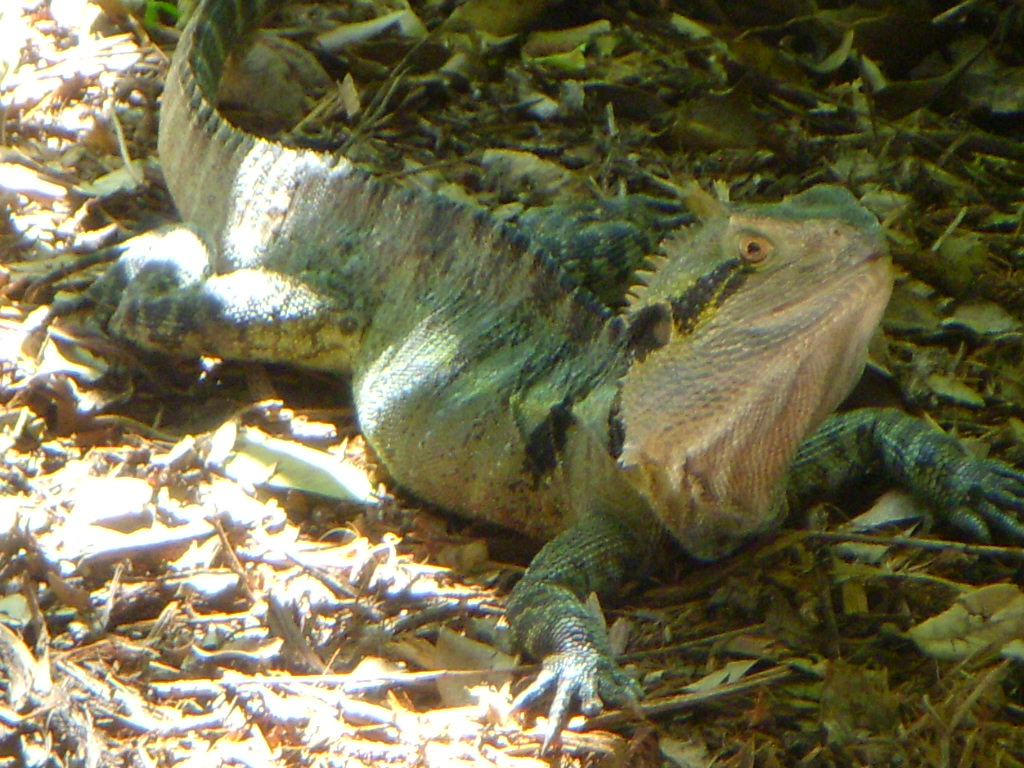
Otherwise the preserve is like a big open zoo, and water dragons were everywhere. I am told they eat anything, and there no food on the ground anywhere despite the fact that hundreds of tourists and their children were eating the food sold in the gift shop. I imagine that explains that.
Overall, I did check this off my bucket list, but if I won't do this again. I thoroughly enjoyed the trip up and back on the Brisbane river, that was actually excellent, but participating in this well-meaning exercise certainly lost it's appeal once I actually did it.
This is what the dingo does to unattended tourist babies. Thank God for that.
Australia uses the terms dollars and cents to describe their currency. An Australian dollar is about eighty US cents. This can lead to minor (and unjustified) sticker shock.
In the first few hours of my visit I was walking downtown Brisbane to find a meal. I still had no idea where things were. I was just wandering aimlessly in the downtown streets. I saw a sidewalk sign advertising a burger and a glass of Australian wine for $20!
Twenty bucks! That should be more like $15. Pass. With a tip that will run up to $25 !!!
It's $16 US, mate. There's no obligatory tipping in Australia. They allow restaurateurs and waitstaff work out wages here. The Australian minimum wage is more than twice the US minimum wage. I overestimated the actual cost of this meal by 50%, or $8 US.
Doh!
Pictured is my receipt from an early morning meal at a bus station McDonald's on the way to Moreton Island, a trip I will detail in a later post. The small coke is still expensive, $2.70 AUD is about $2, but I made the contemptible error of declining to either make it a meal (declining the greasy potato patty they call hash browns here too) or to super-size it.
My meatless EggMcMuffin and a small Coke was $6.15 AUD, or about $5 US. Still pricey for a bus station, but like I said, it probably would have been less if I accepted delivery of the potato grease bomb.
I did spend less money on this trip than I thought I might. This kind of over-reaction caused me to pass by a number of meals, souvenirs, and events. On balance, that was probably a good thing.
This water dragon asked me
what the f*ck is wrong with America
In the last six months I have gotten to know some Australians in the US for a two-year stint of college work. They moved here last Autumn. This wasn't any direct cause of my curiosity about Australia as a place to immigrate, but as I tried to help them get used to American idioms and norms they introduced me to some of theirs. "She's all good" is one of them I didn't really get until I visited. It is used very frequently, perhaps only behind "no worries" and "g'day" in frequency in my brief experience here.
Coming back from the beach on the bus I had a conversation with an American who immigrated here from NYC about a year ago. She translated it for me into American English in a way my Aussie friends couldn't: "calm down, things work out, it's not worth getting upset over."
Australia is of course bigger than a single phrase, but this does kind of sum up one of it's main charms. I don't mean to cartoon caricature Australia, but so far I have met Crocodile Dundee about a dozen times. By that, I mean the warm charm mixed with fearless self-reliance in that character is fully present in many Australians. Smiles are everywhere, and being here has made me better appreciate what has changed in the US that bothers me so.
I have been struggling privately for a few days with finding a cup of coffee. Ordering "coffee" here is like going into a restaurant and ordering "food." You will get a quizzical look followed by a pause, waiting for you to finish your order.
At first, and this is one of the things that is thoroughly American about me, I would glance up at the menu in a panic and order something off the list rather than display my ignorance. I finally gave that up today on the ferry back from Moreton Island, a sand island 25 miles or so off the Brisbane coast that I will be blogging about soon. I walked up to the smiling woman about my age behind the counter and confessed "I want a coffee, but I'm an American and I don't know how to order it."
"Oh darling," she said as she reached out and patted my hand, "I know exactly what you mean. It took me almost a week before I was able to go out and order my husband's coffee correctly when we visited up there last year."
"What does he drink?" I asked.
"You call it 'Americano'." she said. "We call it a 'long black.'"
"Oh THAT'S what a long back is" I said. "What's a short black?"
"Less hot water, otherwise the same." she said with a big smile. She held up her hand, pinching her thumb and forefinger "A long black is this much water" then shortening the distance between her thumb and finger "and a short black is this much."
We had a good laugh as she made my coffee, she told me about some other funny things that happened during their visit to the States. I felt as though I made a new friend. The coffee was perfect.
Australians seem to love being asked for help. Rather than trying to figure out their coins, I've taken up holding a handful of them out in my hand when paying for something and saying to the cashier "I'm American, help me figure out which coins to give you."
They smile and pick the right change out of my hand.
The most valuable coins, $2 coins, are the smallest. Come 'on, Australia! Queen Elizabeth II's picture is on all the money.
I have had ABC News (Australian Broadcasting Company, what PBS could in the US if we funded it adequately) on constantly in my hotel room. South Australia is having a major election right now, so that's dominating the coverage. I'm afraid Australian politics seems to be following US politics down a dark road. I hear the same deceptive polemics about fracking, for example, that we heard in the US during the Bush years.
SA Best is a thinly-disguised Trump-like populist movement in South Australia, which is a state of the country of Australia, like Queensland or New South Wales. Adelaide is it's capital. You see the same shill politicians crowing the same BS about "growing the economy"when the real agenda is clearly stripping public services, serving big business and giving governmental resources to the wealthy.
There's also a hint of Southern US style racism in a recent proclamation about white South African farmers being more favored immigrants because "they're the kind of people we want here." Apparently, there's a problem with white South African farmers being forced off their land, or that's the story anyway. The SA Best politician compared them to Rohingya migrants from Myanmar, arguing they should be offered political asylum by a "civilized country."
Australian reporters don't cower to power. I watched a woman take apart one of the SA Best candidates while he tried to give Sarah Huckabee-Sanders-esque answers to her questions. "if you aren't going to answer me, why are you talking to me at all?" She asked sharply. "Yes or no questions deserve a yes or no answer" she advised the stammering blowhard in a suit as she turned away from him.
This gem is from their website:
Q. Who will you support to form government? Liberal or Labor?A. This is a very important question. Both major parties have shown scant regard for what is right for our state. And based on past history, their election promises are discarded or broken when it suits them. Any decision we make will depend on a range of factors, including the views of elected members and their electorates, which party receives the most votes and seats and above all which party can best deliver the SA-BEST agenda.
Q. Who are you preferencing?A. SA-BEST exists to give you, the voter, a genuine third option so that you don't have to vote for Labor or Liberal. We haven't preferenced any of the major parties, and are leaving it up to voters to allocate their own preferences.
The election is too close to call, something else that is unsettling familiar to US politics. These racist, civil disruption polemicists somehow get attention here too and they are believed to take votes more from one side (Liberal) than the other, although, like the US, no one really knows. Electricity rates and supply are a major issue in South Australia, SA Best's solution is privatization. Yeah, that's going to go well.
So, Australia is no utopian escape for me from Trumpism, but I don't hold that against it. I'm afraid this jingoism is infecting the entire planet.
As I will discuss in another post about a conversation I had with a riverboat captain here I have found that my suspicion about Australia is true. I fit here. This is a culture imbued with kindness and cooperation. There are so many examples of local governments stepping in to right a social wrong that I can't keep track of them all. It's messy, and they do fail, but the government here genuinely tries to help. That's very refreshing
I do genuinely feel that the Australian cultural zeitgeist suits me in a way that America's no longer does. This is only part of the information I need to make a decision about immigration, but it's that part that I had to visit Australia to find out.
I have only been here a few hours, so I can't really say much about Brisbane yet. Let's get caught up on the trip to get here. It was my first overseas flight of that duration.
My last post got me to Newark. The flight to Vancouver was fairly comfortable. It was only about half full, so even in economy class there was plenty of room. I watched The Darkest Hour on the video service. The fun started when I got to Vancouver.
Vancouver has a beautiful airport, modern and spacious. On my way to meet my connection to Brisbane I was stopped at a desk and asked to show my boarding pass for the flight I just got off of.
"It was a boarding pass," I said, emphasizing *boarding.* "Once I boarded the flight I threw it away. I had a leg of my original itinerary cancelled and I had to rebook from a different airport. I had so many boarding passes I got rid of the ones I didn't need."
"We will have to call security" said the young man at the desk.
"Because I don't have the boarding pass for a flight I just got off of?" I said. "Obviously I had one, I boarded the flight. That's what a boarding pass is used for. Once I am on board, I don't need it anymore"
I felt outrage arise within me. I was at risk for really flying off the handle here.
Instead, I sat there while they notified the security people. It was 1:30 am in the morning in Vancouver. No one else was around. It was just me.
It turns out what they wanted me to do was go back through a special area of passenger screening as if I had just driven to the airport to get on the flight. Ok, this is a stupid as stupid gets, I could not be in the area of the airport I was in if I had arrived by any other method than a commercial flight, but reason wasn't going to get me anywhere.
The Canadian border security guy was nice enough, but my boarding pass for the flight that I need to get on next wouldn't scan in his system. After carefully examining it, we discovered it was for the wrong date. It seemed that the gate agent in New York had booked me on a flight that was scheduled to depart a full 24 hours later from Vancouver to go to Brisbane.
"Air Canada made a mistake here." I said. "Don't you think they would have told me about a 24 hour layover in Vancouver?"
The border agent was sympathetic. "Since there's nobody else here, let me run down to the Air Canada desk and see what they say. If I sent you out there to resolve this yourself that would cause you to have to re-screen in another part of the airport and I don't think you would make your flight."
"Ok" I said. I was seriously considering the possibility that I might see a bit of Vancouver before I ever got to Brisbane. I did purchase travel insurance. My coverage had been triggered by the cancellation, so if I needed to spend some money here I had resources. This would be at most a hassle, it wasn't going to cost me money in the long run.
After a few minutes he returned and explained the problem was with his system. The boarding time for the flight was on one day, the flight was on the next day. Somehow, that messed this all up.
He put my stuff and me through the xray and sent me on my way.
I got to the gate after my boarding group had already been called, so I literally walked right on to the plane, never breaking stride from the security SNAFU. I felt myself lucky to be on another mostly empty flight. I had another row to myself in economy.
That was important because I could stretch out horizontal across three narrow economy seats to sleep. It was a 14 hour flight.
I got more sleep than I expected. I also had time to watch Cabaret, Singing in the Rain, and Blades of Glory on the video service. It was like hanging out on the couch for fourteen hours. It did not turn out to be the endurance challenge I expected.
Passing customs in Australia was a matter of navigating a series of electronic kiosks. It seems like they could do all this at one stop, but what do I know? My bag was the second one to come off the baggage carousel. Cabs were waiting out front. The driver knew my hotel when I mentioned it to him.
I've showered and had a little rest. Now it's time to go explore Brisbane.
It had been an unusually stress-free day. I was packed. I had lunch with a good friend at a favorite restaurant. I had plenty of time to do everything. I hailed a cab and went to the airport.
I had butterflies when we rounded the corner to drive up on terminal B at LaGuardia. That surprised me. Here we are, we are actually going to do it. I am going overseas alone. I had a reaction to this in my stomach.
I had my boarding pass printed out from home. I had a bag to check, so I went to the bag drop line. It was long. I arrived at the end of the line right behind a group of young Asian women whom I deduced were a touring singing group. They all wore the same jacket and all were dragging at least two large suitcases each.
They formed a makeshift table by pushing their bags together like a pedestal. They broke out some mango cut up in a container and a bag of Asian cookies for lunch. They were obviously very used to their routine. They stood around and had an impromptu meal while we were waiting in line to check bags.
I know that seems odd, but the line wasn't moving. At all. That was my first clue that something was up.
After standing in line behind the same twenty souls for more than half an hour I decided to check the status of my flight. Cancelled. Not late, not delayed. Cancelled. I had two connections to make from this flight. My trip was about to get interesting, and not in a good way.
Ah, that's why all of these people are standing at the bag drop counter not dropping bags.
To make a long story shorter, after another twenty minutes standing behind the Asian pop group I finally got to see an agent. He worked silently and diligently for about 15 minutes. He would stop every few minutes, look up, and say "I'm still working on your options."
The first option he had given me was to simply fly 24 hours later. I asked him if I could re-book my return without paying a change fee, sniffing a solution. I have travel insurance, it went into effect when the flight was cancelled. He told me he could not make any such assurance.
"Really? Well, keep trying then."
He finally booked me on a flight out of Newark that makes it possible for me to make my connection to my original flight leg to Brisbane. I am now at the Newark airport after a loud bumpy trip on a dirty bus awaiting a chance to board the flight to Vancouver. We will see if I can make the connection and get back on my normal itinerary.
In twenty hours I will be en route to Brisbane. My bags are packed except for those few things I will be using between now and the time I leave, like my toothbrush and razor.
As I have written before, this is the first time I have travelled solo. I have travelled alone before. I have travelled to visit people alone. I have travelled alone to meet someone for more travel together after that. I have never traveled solo, just for myself.
I just received an e-mail from a friend who travels solo quite often. I was pleased to get it;
"Solo travel is the best! Do your own thing on your own schedule. Plus, as a couple or group, you are insulated from other people. By yourself you are much more likely to meet people."
I had not thought about that. I realize I have had a covert belief that an experience like travel is always best by being shared with someone. I realize I accepted this as true for me as if my mind was made up on purpose about this issue long ago. Really? When did I do that?
Life is about getting free of unexamined beliefs. The trick is seeing them. I confuse unexamined beliefs with reality. I think I am seeing reality, but I am really just seeing my thoughts. I have never really asked myself if I wanted to travel alone. I told myself that would be a waste, I would regret it, and I killed the idea before it had a chance at life.
This is a good place to point at something in the First Precept of Buddhism. I killed this idea of travelling solo against the advice of the first precept. This teaching points to many things, but one thing it points to is a warning that if you so fully object to something that you want to kill it, be that a person, a relationship, or an idea, then you have already lost direct contact with reality. One does not want to kill anything before one has a concept of it, that is, one must have an idea about something, something that separates it from the things around it, in order to kill it. Pre-concept. Precept.
I respond when I notice that I have been caught by a concept by taking a breath, checking my posture, and opening my eyes as if I have never seen any of this before. I may find solo travel the most meaningful thing I have ever done in my life. I may find solo travel disappointing for the reasons I have accepted as true all these years. I am about to find out.
Eyes open, soft focus. How's your breathing? How's your posture? Once I answer those questions for myself, other answers soon follow.
If you've spoken with me in the last couple of months you know I am going to Brisbane, the capital of Queensland, the northeast part of Australia, in March. There are a number of reasons for this choice, but if I had to combine them all in one word, it would be "adventure."
On the one hand, this is part of a very serious deliberation concerning permanent immigration out of the United States. Should this country persist in the current march towards Emperor Trump and the New Free States of America, I will be permanently moving to a country with a democratic form of government and a national health system. Australia, while it has it's own problems, cultural and political, is on my short list along with english-speaking Canada and Scotland.
It is also the most distant, and in some ways the most difficult to explore, so I'm going there first. I am truly curious about what it feels like to me to be in a different hemisphere, far from where I have always lived. I know what others say about this experience, I want to feel it in my own bones.
My choice of Brisbane was really rather random, and I intended that. I felt visiting Sydney, at least primarily, might be a bit like coming to New York City as a way to get introduced to the US. If one were to do that, one would get a taste of the US zeitgeist, but you would lack exposure to very large and important aspects of American culture because NYC is really the westernmost city of Europe.
I would recommend to a person desirous of genuine exposure to the USA (by visiting the Northeast, anyway) that they visit Philadelphia, DC or Boston primarily and make a side trip to NYC. That would expose them to a much wider spectrum of people, norms everyday lifestyle in the USA than booking a nice hotel on Sixth Avenue for a week would, even though that might be more fun and comfortable.
Brisbane also has an office for a software company that I know well, so it's likely to have companies there with jobs appropriate for my skills, it is closer to the countries of the Pacific Rim I want to visit, and I have an online acquaintance who lives there whom has been helpful with practical aspects of the trip like where to stay and how to plan to get around. I plan to visit Sydney also, as a side trip.
Aside from that, I know next to nothing about it other than what I've read in the last few weeks. It's on the coast, there's a resort area nearby called Gold Coast that looks like Miami or what Atlantic City might have been. There's beach, hotels, theme parks, etc. I generally eschew that kind of stuff in the US, so I'm going to go down there to expose myself to something I might not like in Australia in order to acquaint myself with the full spectrum of the zeitgeist.
I want to see some Australian animals and plants, there's a koala preserve and a national park in the area, as well as botanic gardens. There's a well known Modern Art museum in Brisbane as well. These are the things I like. This might be why Brisbane might also be a good place to settle, as well as a gateway to understanding myself in this country.
It is also the first time in my life that I have gone this far from home, and also the first time to make a major trip alone. Like a frog sitting in a slowing heating pot of water, too much of my life has passed while I have waited for something that, or someone whom, I can't quite name, someone who sees travel precisely as I do, or some opportunity to do this in a less scary way. I've been awaiting some physical manifestation of a travel muse, a person who wants to go to exactly the same places for the same reasons I do, or for some plan to emerge that is so convincing it removes all doubt.
No more. I'm going that-a-way, folks. I'll write when I get work.
Seriously, I will be blogging the trip here. I will tag those posts like this one.
I am seeking Australia, I am seeking my next home, I am seeking deeper self-knowledge, I am seeking a good meat pie. I have no idea what I will find, I'll do my best to tell a good story here.